Coalition warns Congress that Nigeria’s foreign-aid bill would police churches and silence atrocity reporting
Brownback, Save the Persecuted Christians, and 49 organizations urge Rep. Riley Moore to press Abuja to withdraw or amend Senate Bill 1034
WASHINGTON, D.C. — Save the Persecuted Christians today released a coalition letter warning that Nigerian Senate Bill 1034 would put independent churches, legal-aid providers, and groups that document attacks on Christians under a political commission with power to register, inspect, sanction, and shut them down.
The letter, addressed to Rep. Riley Moore (R-W.Va.) and copied to House Africa Subcommittee Chairman Christopher Smith, Appropriations Chairman Tom Cole, the U.S. Commission on International Religious Freedom, and the State Department’s Office of International Religious Freedom, is signed by former Ambassador at Large for International Religious Freedom Sam Brownback, STPC President Dede Laugesen, and an additional 44 individuals and 49 organizations.
“Transparency in public finance is a legitimate objective. This bill is not a narrow anti-corruption measure,” the letter states. “It would place independent churches, humanitarian partners, legal defense funds, and researchers who document attacks on Christian communities under a political commission with discretionary power to starve them of support.”
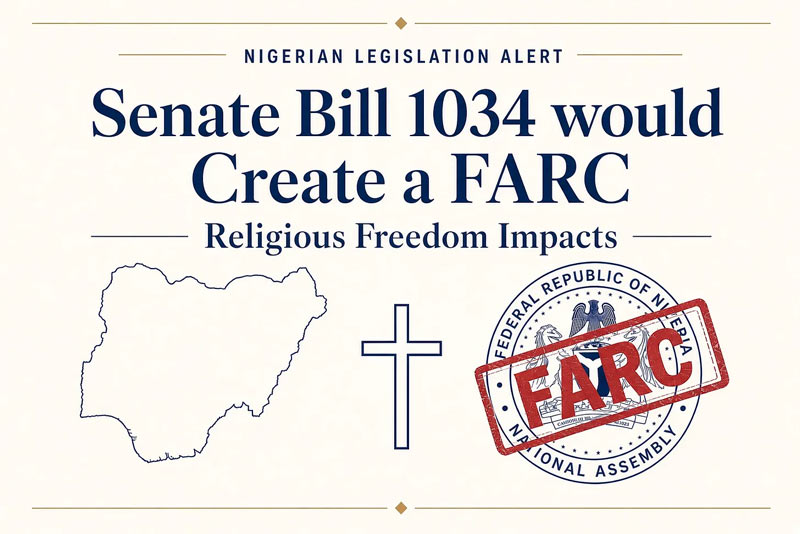
SB 1034, the Foreign Aids (Regulation, Transparency and Disclosure) Bill, 2026, sponsored by Senator Ibrahim Hassan Dankwambo (PDP, Gombe North), was introduced on May 6 and passed second reading on July 22. It remains before Senate committees and has not reached third reading or the House of Representatives.
In its current form the bill would create a Foreign Aid Regulatory Commission and:
- Require registration of any foreign aid within 30 days of receipt, with failure to register treated as a criminal offense.
- Mandate public disclosure of sources, amounts, purposes, conditions, implementing partners, and funded activities.
- Require foreign-funded activity to “align” with Nigeria’s national development plans — a standard broad enough to brand documentation of rights violations as out of alignment.
- Authorize fines reported at up to ₦20 million, imprisonment of up to five years, and suspension or revocation of operating licenses.
The Catholic Bishops’ Conference of Nigeria, after its September plenary, called on the National Assembly to halt the bill, objecting to language that would let authorities refuse registration when activities are deemed not “in the national interest.” Human Rights Watch, SERAP, the Nigerian Guild of Editors, and the Nigeria Network of NGOs have issued similar warnings.
The coalition argues that a public register of implementing partners would hand hostile actors a map of congregations already targeted by Fulani militants, Boko Haram, and ISWAP, and that a 30-day registration clock could freeze emergency relocation and legal defense for pastors, witnesses, and displaced families. Over time, Congress and USCIRF would receive a thinner, more state-managed account of conditions on the ground — precisely when Nigeria remains a Country of Particular Concern and U.S. policy is demanding a reliable accounting of persecution and of aid delivered through faith-based partners.
The letter asks Congress and the State Department to seek a written assessment of the bill, urge Nigerian counterparts to withdraw it or add explicit safeguards for human-rights defenders and confidential protection work, and treat its movement as a factor in CPC diplomacy, assistance-conditionality certifications, and further appropriations language on Nigeria. It also endorses an IRF Roundtable Africa Working Group request to Senate President Godswill Akpabio for an expedited track for emergency legal defense, medical care, and relocation, outside ordinary registration timelines and penalties.
Signatories include former Rep. Frank Wolf, Open Doors US, National Religious Broadcasters, Genocide Watch, Mercury One & The Nazarene Fund, the Shai Fund, Jubilee Campaign, Boat People SOS, and Nigerian-American and Nigerian partner groups including the Christian Association of Nigerian Americans, the LEAH Project, and Accountability Lab Nigeria.