
Trapped by Lawfare: Former U.S. Ambassador Morse Tan’s Trial Begins in South Korea
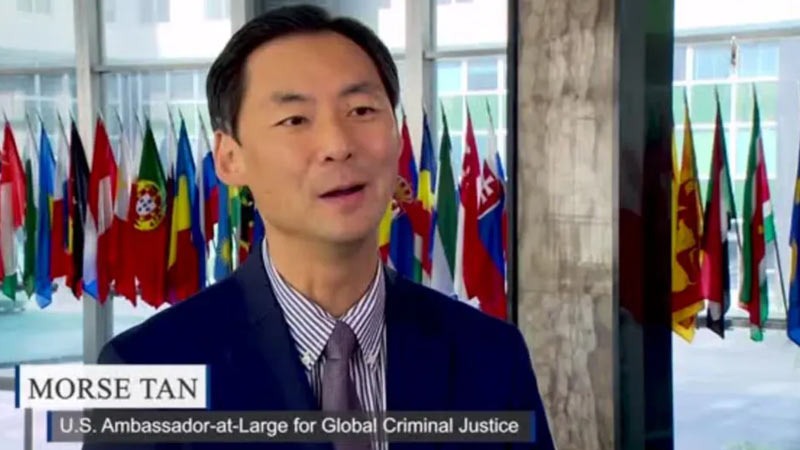
(Washington, D.C.) — A free-speech case that American media largely ignored is now heading to court. Save the Persecuted Christians first brought it to light.
Tomorrow morning, Friday, October 16, 2026, at 11:30 a.m. Korea time, former U.S. Ambassador-at-Large for Global Criminal Justice Morse H. Tan will appear for the first hearing in a criminal defamation trial in Seoul. The charges stem solely from remarks he made on American soil more than a year earlier—at the National Press Club in Washington, D.C., in June 2025—concerning South Korean President Lee Jae Myung.
Tan, a Korean-American U.S. citizen who served in the first Trump administration from 2019 to 2021, has been barred from leaving South Korea since late May. Successive exit bans have kept him in the country for more than four months. Most recently, a Seoul court refused to lift the restriction long enough for him to attend the funeral of his 103-year-old maternal grandmother in the United States.
This is the story that mainstream American media largely ignored until alternative voices and advocacy organizations forced it into the open.
Breaking the Silence
In mid-July 2026, Save the Persecuted Christians (STPC) published “Trapped by Lawfare: Former U.S. Ambassador Morse Tan Held in South Korea Under Politicized Exit Ban.” The piece detailed how Tan, a longtime advocate for religious freedom and accountability for atrocity crimes, had been placed under an exit ban after arriving in South Korea to observe local elections amid widespread claims of irregularities and foreign interference.
STPC President Dede Laugesen explained that she learned of the situation from a comment on X, reached out to Tan directly, and confirmed the details. Tan himself told her he was concerned the case was receiving almost no attention in the United States and asked for help exposing what he described as “CCP-like lawfare.”
The article noted the near-total blackout in major U.S. outlets on a case involving a former American diplomat, protected speech delivered in the United States, and an exit ban imposed by a treaty ally. Coverage at the time was limited to alternative media, Korean conservative channels, and platforms like X under the hashtag #FreeMorseTan.
Subsequent reporting from outlets such as The Epoch Times, National Review, the Christian Post, and others followed. Former Ambassador-at-Large for International Religious Freedom Sam Brownback publicly called the treatment “shocking” and urged the Trump administration to intervene. A group of Republican members of Congress sent a letter criticizing the “remarkably unfair” handling of an American citizen for speech made in the United States.
The Charges and the Exit Ban
Tan is accused of defaming President Lee by repeating claims that Lee, as a teenager, was involved in a serious crime involving a young woman, was sent to a juvenile detention center, and therefore did not attend middle or high school. South Korean authorities treat the statements as false. Tan maintains he was referring to information already in the public domain and that he possesses material evidence supporting the underlying allegations.
Police initially closed the investigation, concluding that a foreign national’s statements made abroad fell outside their jurisdiction. Prosecutors reopened the case, arguing that the effects were felt in Korea where the alleged victim resides. Tan was indicted without detention in mid-July 2026 under South Korea’s Information and Communications Network Act and the Criminal Act. Potential penalties, if convicted, include up to five to seven years in prison depending on the specific count, along with possible fines and suspension of qualifications.
The exit bans began shortly after Tan’s arrival in late May. Courts have repeatedly upheld the restrictions, citing public interest and the need to ensure his participation in proceedings. On October 8, the Seoul Administrative Court acknowledged that the ban caused urgent, potentially irreparable harm in the context of his grandmother’s funeral but still refused to suspend it.
Tan has dismissed prior counsel and is now represented by attorney So Jeong-im.
Tan’s Legal Strategy
Tan, a former law professor and dean at Liberty University with expertise in constitutional and international law, has publicly framed the case as lawfare—the weaponization of legal process against protected political speech.
His core arguments, articulated in interviews with National Review, the Daily Caller, Lindell TV, and others, and in court appearances related to the exit ban, include:
– Lack of jurisdiction: South Korean courts have no authority over speech by a U.S. citizen made on U.S. soil.
– First Amendment protection: The remarks concerned a public political figure and were delivered by an American citizen in the United States—core political speech.
– International standards: South Korea is a party to the International Covenant on Civil and Political Rights. Article 19 protects freedom of expression; restrictions must be necessary and proportionate. Criticism of public officials receives heightened protection under human rights standards.
– Korean domestic law: Tan has argued that, under the standards applicable at the time of his statements, speech believed to be true and made in the public interest is protected.
– Due process concerns: He has alleged inadequate notice and procedural irregularities.
– Factual defense: Tan has stated publicly that he has documentary, testimonial, and circumstantial evidence regarding the underlying claims and that, were he a prosecutor, he would have sufficient grounds to proceed.
He has characterized the proceedings as “not the rule of law” and has warned that the case risks damaging the U.S.–Republic of Korea alliance.
Broader Context
Tan has described South Korea under the current administration as facing rising authoritarian pressures, including what he and other critics call significant Chinese Communist Party influence operations. He has spoken at churches and public events while under the exit ban, including a tearful tribute to his grandmother at Unjeong Chamjon Church in Paju, where he recalled her lifelong Christian faith and daily prayers for her family.
The case has drawn attention from religious freedom advocates because Tan’s background includes work on Christian persecution and atrocity crimes, and because conservative Christian communities in South Korea have faced heightened legal and political pressure in recent years. STPC and others have framed the exit ban as part of a pattern in which dissent is met with legal mechanisms rather than open debate.
Whether one accepts Tan’s broader characterizations of South Korean politics or not, the narrow legal facts remain striking: an American citizen and former U.S. diplomat is being tried in a foreign court for political speech delivered in Washington, D.C., and has been prevented from returning home for months.
What Comes Next
Tomorrow’s hearing will mark the formal start of the trial. Proceedings will be in Korean. English-language coverage, translations of key arguments, and any rulings will depend on subsequent reporting from Korean and international outlets.
Save the Persecuted Christians continues to track the case and has called for U.S. officials to press for the lifting of the exit ban and the dismissal of charges that criminalize protected American speech. The organization first documented the blackout and the human cost—including Tan’s inability to bury his 103-year-old grandmother—when few others were paying attention.
As the trial begins, the question is whether American institutions and media will treat the free-speech rights of a former U.S. diplomat as seriously as they treat similar cases when the foreign government involved is not a formal ally.
Stay tuned to Save the Persecuted Christians for updates.
#FreeMorseTan