The Church’s silence on China’s egregious violations of religious freedom
Is it not time for the Pope to speak out and pray publicly for Jimmy Lai and other persecuted Christians?
By UCA News | January 14, 2026
Xi Jinping’s sweeping crackdown on unregistered Christians across China intensified as this year began, with a new wave of arrests and repression.
Last week, Li Yingqiang, the leader of one of China’s most prominent unregistered Protestant churches, the Early Rain Covenant Church in Sichuan province, was taken from his home in Deyang by police, along with his wife and five other church leaders. They remain in detention without any public charges.
The US Congress’ Select Committee on China said they were arrested because they refused to “bow” to the Chinese Communist Party (CCP) regime, which has imposed new restrictions that effectively criminalize unauthorized online Christian worship.
Two days earlier, on Jan. 4, a church in Yayang Town, near Wenzhou in Zhejiang province, was targeted once again, with special police forces encircling it and cordoning off the surrounding area.
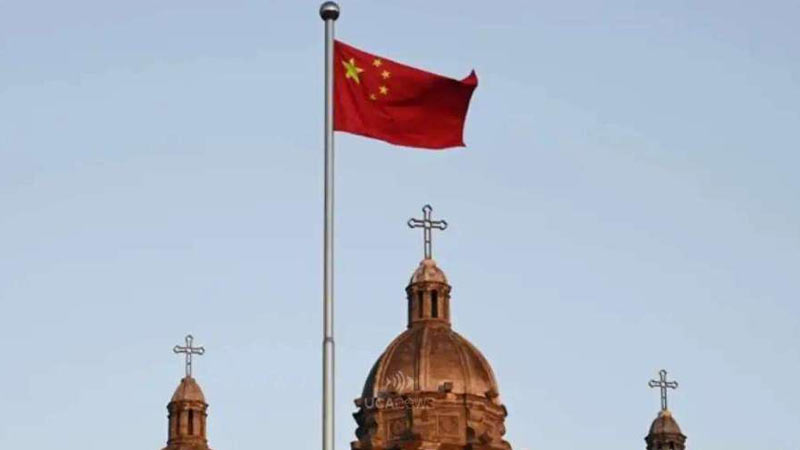
Equipment, including cranes and bulldozers, was brought in. Two brave reporters from Agence France-Presse visited the church last week and confirmed that the cross atop its steeple had been demolished.
The Yayang Church — which is the central place of worship for a network of 12 independent house churches in the area — was previously targeted in December 2025, when more than 1,000 police — including special police, riot police, and firefighters — surrounded and stormed the church building.
Several hundred worshippers who were inside the church were detained, although later released after having their personal details registered. But at least 20 remain under arrest.
Police issued wanted notices for two local church leaders, Lin Enci and Lin Enzhao, describing them as “principal suspects of a criminal organisation” accused of “picking quarrels and provoking trouble.” They had previously publicly opposed the forced installation of the national Chinese flag at the entrance to the church. Both men were taken into custody.
The crackdown on the Early Rain and Yayang churches follows the arrest last October of senior members of the Zion Church, another prominent unregistered Christian network across China. At least 18 Zion Church members, including the founder, Pastor Ezra Jin Mingri, remain in prison.
This intensifying crackdown on unregistered churches is part of a pattern of increased persecution of Christians specifically — and religion more broadly — under Xi Jinping’s regime.
In 2018, Early Rain church’s founder, Pastor Wang Yi, a prominent human rights defender and legal scholar, was arrested along with 100 other members of his church, and a year later, he was jailed for nine years for “inciting subversion of state power.”
Last September, China introduced new regulations banning unregistered religious organizations from disseminating sermons online. In the same month, Xi chaired a meeting of senior Chinese Communist Party (CCP) Politburo members, focused on advancing his campaign of “Sinicization of religions.”
For the CCP, Sinicization is not about culturalization of religion — adapting it to the Chinese cultural context — but rather about political coercion and co-option of religion to be loyal to the Party and its ideology. Furthermore, the classification of Christians as “unregistered” functions as a mechanism of state control under Chinese law and policy.
Over the past decade or more, the campaign has involved the destruction of thousands of Christian crosses, forcing churches to display portraits of Xi and other leaders and CCP propaganda banners, introducing facial-recognition surveillance cameras at the altar to record worshippers, prohibiting foreign preachers and missionaries from working with Chinese churches, and banning under-18s from places of worship.
In Hong Kong, although freedom of worship is less curtailed than in mainland China, efforts to advance the “Sinicization” campaign have accelerated, with several conferences between Protestant and Catholic groups in Hong Kong being held to discuss the topic.
Clergy in Hong Kong now self-censor their sermons to avoid preaching on topics and themes that may be politically sensitive, particularly relating to freedom, human rights, justice, and democracy.
And Hong Kong’s most prominent lay Catholic, 78-year-old media entrepreneur and British citizen Jimmy Lai, faces the prospect of the rest of his life in jail. Lai was convicted on Dec. 15, 2025, under the draconian National Security Law on the charge of “conspiracy to commit collusion with foreign forces” and under the Crimes Ordinance of “conspiracy to publish seditious publications.”
Earlier this week, Lai appeared in court for his mitigation hearing. He is expected to be sentenced in the coming weeks, facing a minimum 10-year term and potentially a life sentence. Given his age and deteriorating health, whatever sentence is imposed may amount in practice to a death sentence in jail.
Lai has already been held in solitary confinement for over five years, with no natural light and less than an hour a day for exercise. He has been denied the right to receive the Sacrament of Holy Communion for most of the past five years.
Last week, Pope Leo XIV delivered a “State of the World” address to the diplomatic corps in the Vatican. The overriding theme of his speech was human dignity, human rights, and specifically freedom of expression, freedom of conscience and freedom of religion.
The pope spoke about several of the world’s other human rights crises, including Ukraine, the Holy Land, Venezuela, Sudan and Myanmar, and reference was made to the persecution of Christians around the world, but no specific mention was made of the plight of the Church in China or the fate of Jimmy Lai.
Leo alluded discretely and implicitly to Taiwan when he spoke of “the intensifying signs of tension and East Asia” and expressed hope for a “peaceful and dialogue-based approach to the contentious issues that are a source of potential conflict,” but went no further than that.
In his explicit silence on the plight of Christians in China, the pope appears to continue the policy of Pope Francis, who barely mentioned the plight of Chinese Christians during his otherwise inspiring papacy.
Given Beijing’s repeated betrayals of its promises to Catholics under the Sino-Vatican agreement first signed in 2018 and renewed for two-year periods in 2020 and 2022 and then for a four year period in 2024, and given the increasing persecution of Christians in China, is it not time for the pope to speak out publicly about one of the most egregious cases of religious persecution in the world today?
Leo has, to his credit, already taken some symbolic steps, such as meeting at a General Audience with Jimmy Lai’s wife and daughter and revealing in an interview last year that he is listening to “a significant group of Chinese Catholics who for many years have lived some kind of oppression or difficulty in living their faith freely.”
Now he should go further, and speak — and pray — publicly for Jimmy Lai, Pastor Wang Yi, Pastor Ezra Jin, Li Yingqiang, and other persecuted Christians in China.